The fastest climate solution is on our plates.
Animal agriculture is the largest driver of global heating, deforestation and biodiversity loss. A shift to plant-based food systems can cut emissions quickly, free up land for nature and feed everyone. We call on COP31 to put food on the table.
until COP31 opens in Antalya
The case in 30 seconds
of the world's farmland feeds animals, yet animal products supply only 18% of our calories and only 12% of our food.
of all greenhouse gas emissions are caused by animal agriculture, once the forests lost to it are counted.
of water are needed for 1 kg of beef: at least six times as much as for 1 kg of tofu.
Our ask to COP31: put plant-based food systems into the 2035 national climate plans immediately.
Read the six demands →Why it matters
Food is a climate issue
Energy and transport get most of the attention, but what we eat shapes the climate far more. Animal farming emits large amounts of methane, a gas that heats the planet far faster than CO₂, and it needs vast areas of land that could otherwise store carbon.
of the world's farmland is used for animal products, yet they provide only 18% of our calories and only 12% of our food.
Poore & Nemecek, Science (2018)of human-caused methane emissions come from livestock.
UNEP & CCAC, Global Methane Assessment (2021)stronger warming effect of methane compared to CO₂ over 20 years.
IPCC AR6 (2021)Animal products: huge footprint, small share of our food
Source: Poore & Nemecek, Science (2018) and UN-IPCC (2014)
Beyond emissions: the wider footprint
Animal agriculture affects far more than the climate. It uses and pollutes water, clears forests, wipes out species, erodes soil, empties the oceans and wastes food that could feed people.
Water use
of water are needed for 1 kg of beef: six times as much as for tofu.
Litres of water per kg of food. Source: Mekonnen & Hoekstra (2012), Water Footprint NetworkWater pollution
dead zone in the Gulf of Mexico in 2024 (6,700 sq. miles), one of the largest in the world. Nutrient runoff from farms starves the water of oxygen.
US factory farms produced 369 million tons of manure in 2012, about 13 times the sewage of the entire US population.
NOAA (2024); Food & Water Watch (2015)Deforestation
of global deforestation is driven by agricultural expansion. Grazing alone causes almost 40%, and much of the cropland grows soy and other animal feed.
The Amazon lost the equivalent of more than 8 million football pitches of forest between 2010 and 2019.
FAO, Global Forest Resources Assessment (2021); Royal Statistical Society (2019)Biodiversity loss
of the 28,000 species at risk of extinction are threatened by agriculture, the main driver of biodiversity loss.
Around 1 million animal and plant species are threatened with extinction worldwide.
Chatham House & UNEP (2021); IPBES (2019)Soil erosion
Animal farming is a leading cause of soil erosion. Overgrazing degrades soil, so arable land is lost and the soil can store less carbon, which is crucial for slowing climate change.
Overfishing
Overfishing speeds up climate change: it weakens the ocean's ability to absorb carbon, destroys natural carbon sinks and adds emissions from industrial fishing fleets.
Seas At Risk ↗Food security
more people could be fed with the crops that are now grown as animal feed. It takes 39 kg of plant food to produce just 1 kg of animal food.
In 2023, 864 million people faced severe food insecurity. Climate change makes hunger worse, and a plant-based food system is the best way to cope.
Cassidy et al., Environmental Research Letters (2013); UN-IPCC (2014); FAO, SOFI report (2024)How big is animal agriculture's share of emissions? It depends on who is counting.
The most quoted figure comes from the UN-FAO. Independent analyses that count methane more accurately, or include the forests lost to grazing and feed crops, arrive at much higher shares.
The FAO runs the Livestock Environmental Assessment and Performance (LEAP) Partnership together with the meat and dairy industry. The International Meat Secretariat, the International Dairy Federation, the International Poultry Council and the International Egg Commission are among its founding partners.
FAO (2013), Tackling Climate Change Through LivestockIncludes uncounted emissions in the UN FAO's Livestock's Long Shadow report and corrects several undercounted emissions within that report.
Goodland, R. & Anhang, J. (2009), Livestock and Climate Change, World WatchAlso includes the potential carbon storage loss of forests and other native ecosystems cleared for animal agriculture. About half the trees on the planet have been cleared for animal agriculture.
Rao, S. (2021), Animal Agriculture is the Leading Cause of Climate Change – A Position Paper, Journal of Ecological Society · SummaryShare of global human-made greenhouse gas emissions attributed to animal agriculture. The figures differ because each study draws the boundaries differently: which gases are counted, over which time frame, and whether lost forests are included.
The solution
Plant-based food systems
Shifting to plant-based diets is the most effective, affordable and immediately available climate measure. It needs no new technology, only political will, good choices and education.
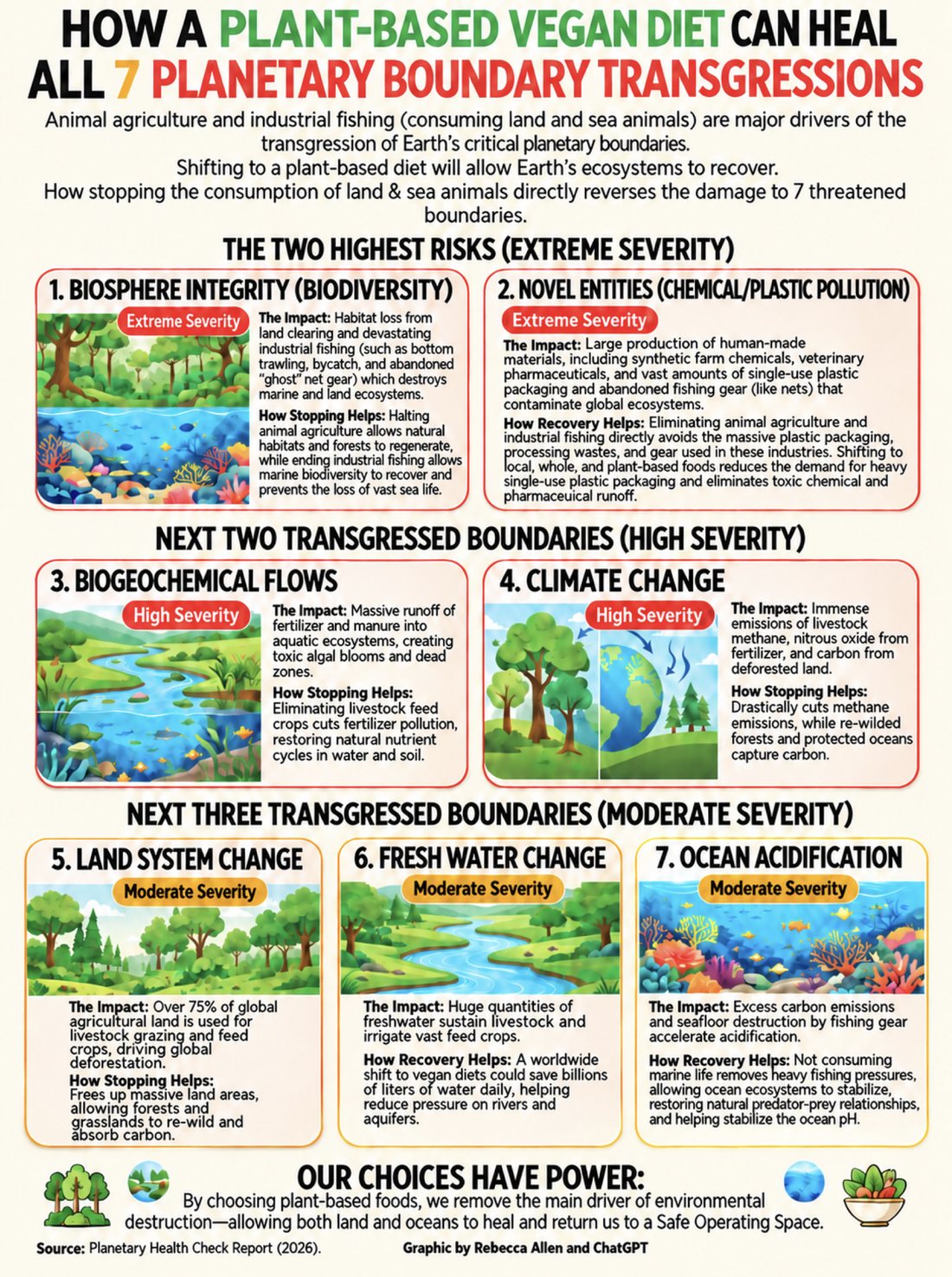
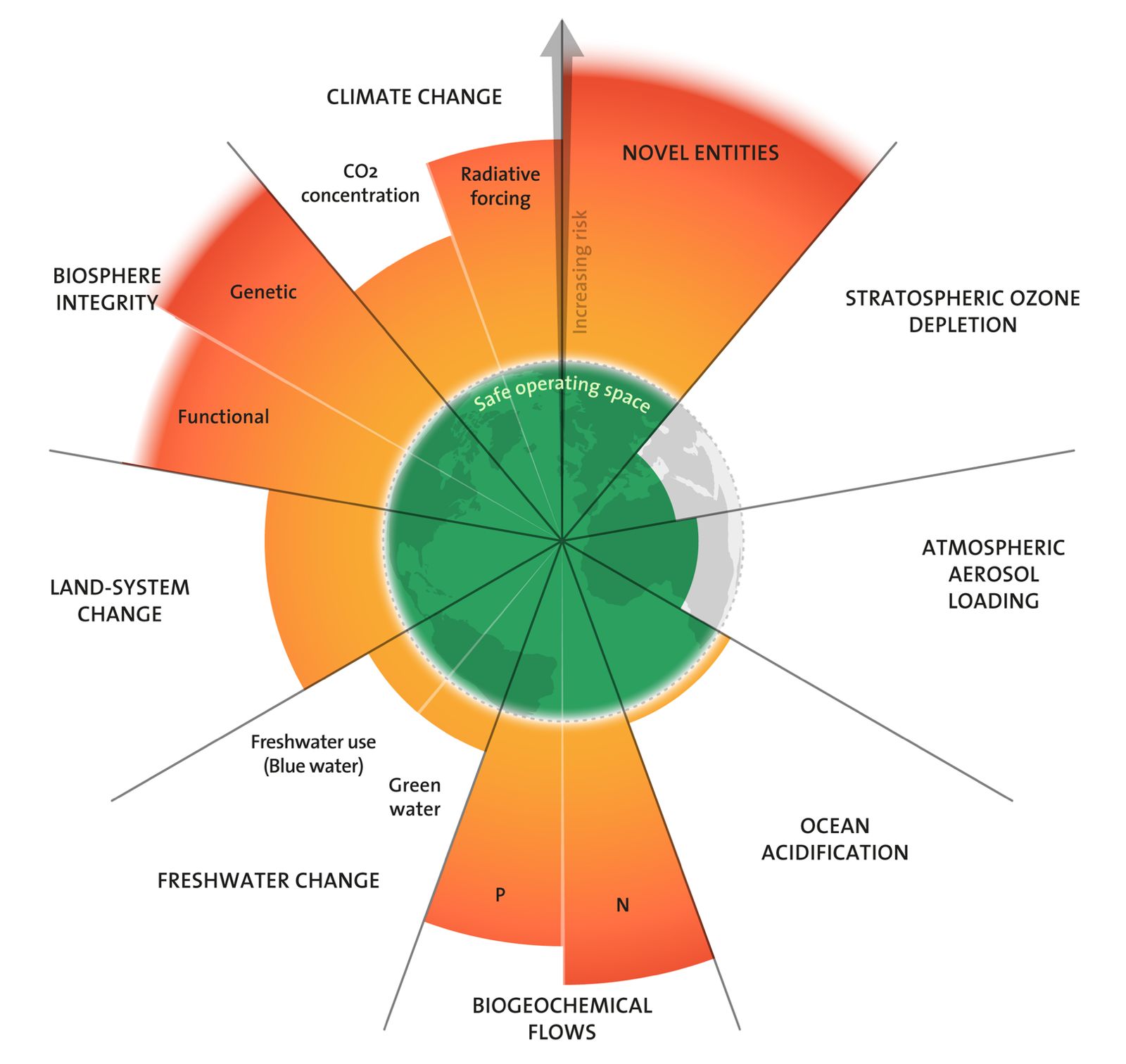
A plant-based vegan diet can heal all 7 breached planetary boundaries.
Click the infographic to see how.
Source: Planetary Health Check Report (2026) ↗Graphic by Rebecca Allen and ChatGPTLower emissions
Vegan diets cause around 75% fewer greenhouse gas emissions than diets high in meat.
Scarborough et al., Nature Food (2023) ↗Land for nature
A plant-based world could reduce global farmland use by about 75%, an area the size of North and South America.
Rao & Shively, Sustainability (2026) ↗Fast results
Methane breaks down within about a decade. Cutting it now slows warming faster than any other measure.
IPCC AR6 (2021) ↗Carbon drawdown
Freed-up land can be rewilded and reforested, pulling hundreds of billions of tonnes of CO₂ back out of the atmosphere.
Hayek et al., PNAS (2024) ↗Water & biodiversity
Plant-based diets use far less water and cause far less biodiversity loss, protecting forests, rivers and oceans.
Health & animals
Well-planned plant-based diets support good health, reduce pandemic risk from factory farming and spare trillions of animals each year.
Your plate, your impact
What difference can you make?
Find out how much water, grain, forest and CO₂ you save, and how many animal lives, on a vegan or vegetarian diet.
Every day, a vegan saves:
- 1animal life
- 4,164 Lof water
- 18 kgof grain
- 3 m²of forested land
- 9 kgof CO₂
Figures: vegancalculator.app ↗
Share the calculator:
COP31 · Antalya 2026
Our message to COP31
From 9 to 20 November 2026, governments meet at the Antalya EXPO Center in Türkiye to turn climate commitments into action. The 1.5 °C goal cannot be reached without transforming food systems. We ask negotiators and delegates to:
Put food systems into national climate plans
Include clear targets for shifting diets and reducing animal agriculture's emissions in every country's 2035 climate plan (NDC).
Details
- How
- Every country is due to submit a new national climate plan (NDC) with targets up to 2035. Add measurable goals for plant-rich public catering, dietary guidelines and food procurement, and for lower livestock numbers.
- Impact
- Animal agriculture causes at least 87% of all greenhouse gas emissions. Plans that don’t eliminate animal agriculture leave at least 87% of the problem unaddressed.
- Builds on
- The COP28 UAE Declaration on Sustainable Agriculture, Resilient Food Systems and Climate Action. More than 150 countries signed it and committed to integrating food systems into their national climate plans.
Tackle agricultural methane
Extend methane reduction commitments to animal agriculture, not only to fossil fuels and waste.
Details
- How
- Set a specific reduction target and timeline for methane from livestock and include it in national methane action plans.
- Impact
- Cutting human-caused methane by 45% this decade would avoid nearly 0.3 °C of warming by the 2040s. Livestock is the largest single source of human-caused methane.
- Builds on
- The Global Methane Pledge (COP26, 2021): cut global methane emissions at least 30% below 2020 levels by 2030.
Redirect subsidies
Shift public money from industrial animal farming towards plant proteins, fruit, vegetables and pulses.
Details
- How
- Gradually shift agricultural support from intensive animal farming to pulses, vegetables, fruit, nuts and plant-protein processing.
- Impact
- Governments spend about US$540 billion a year supporting agricultural producers. 87% of it distorts prices or harms nature and health (FAO, UNDP & UNEP, 2021).
- Builds on
- The Kunming-Montreal Global Biodiversity Framework, Target 18: reduce harmful subsidies by at least US$500 billion a year by 2030.
Support a just transition for farmers
Help farmers move to plant-based production with training, fair funding and secure incomes.
Details
- How
- Fund retraining, investment in plant-protein value chains and income guarantees during the transition, designed together with farmers.
- Impact
- A transition that farmers help shape moves faster and keeps broad public support.
- Builds on
- The Just Transition Work Programme under the Paris Agreement, established at COP27.
Restore freed land
Use land no longer needed for grazing and feed crops for rewilding, reforestation and carbon storage.
Details
- How
- Restore former pasture and feed-crop land to forests, wetlands and grasslands, respecting the rights of local and Indigenous communities.
- Impact
- Restored ecosystems draw CO₂ out of the air and bring back biodiversity at the same time.
- Builds on
- Kunming-Montreal Target 2 (30% of degraded ecosystems under restoration by 2030) and the Glasgow Leaders' Declaration on Forests and Land Use (halt and reverse forest loss by 2030).
Lead by example
Make plant-based food the default at COP31 and all future climate conferences, and implement it in all nations.
Details
- How
- Serve plant-based meals as the default everywhere, starting at climate conference venues, with other options available on request.
- Impact
- As everyone experiences the solution first-hand, personal, national and global carbon footprints will fall.
- Builds on
- Behavioural research: default options strongly shape what people choose, in canteens as elsewhere.
Beyond COP31: Our long-term roadmap
Following COP31, our focus shifts to tracking national commitments as governments update their 2035 Nationally Determined Contributions (NDCs). We will use the UNFCCC NDC Registry, the Climate Watch NDC Tracker and the Climate Action Tracker (CAT) 2035 Update Tracker.
We will continue working alongside civil society, policy experts and agricultural communities to ensure that plant-based food system targets are integrated into national policies, funding mechanisms and public procurement frameworks long after the summit concludes.
From the host country
The solution is already on the table in Antalya
Turkish cuisine is rich in dishes built on lentils, beans, bulgur, vegetables and olive oil. Many classics are plant-based by tradition, with no substitutes needed.
Red lentil soup with mint and lemon.
Patties of red lentils and fine bulgur with fresh herbs.
Vine leaves stuffed with rice, herbs and pine nuts, cooked in olive oil.
White bean salad with onion, parsley and sumac.
Green beans slowly braised with tomato and olive oil.
Spicy bulgur rolls, today usually made without meat, served in lettuce leaves.
Plant-based eating is not a foreign idea anywhere. It is part of every region's food culture.
Take action
What you can do today
Try it for 30 days
Start with a one-month plant-based challenge. Programmes like Veganuary offer free recipes and daily tips.
Swap step by step
Replace dairy milk with oat or soy milk, and meat with lentils, chickpeas, beans or tofu.
Eat well
Plan balanced meals and take a vitamin B12 supplement, as recommended for everyone on a vegan diet.
Raise your voice
Sign petitions, write to your government's COP31 delegation and share this page before November.
Resources
Watch & learn
Read & learn
New · AI guide
Sage
A free AI search companion by Climate Healers, built with climate awareness and compassion. Ask it anything about healthy, kind and sustainable living, on the web or right in your browser.
Spread the word
Flyers
Download our flyers, print them and share them at COP31, in your city or online.
Scientific sources
- Poore, J. & Nemecek, T. (2018). Reducing food's environmental impacts through producers and consumers. Science 360, 987–992. doi.org/10.1126/science.aaq0216
- Scarborough, P. et al. (2023). Vegans, vegetarians, fish-eaters and meat-eaters in the UK show discrepant environmental impacts. Nature Food 4, 565–574. doi.org/10.1038/s43016-023-00795-w
- FAO (2013). Tackling Climate Change Through Livestock. fao.org
- UNEP & Climate and Clean Air Coalition (2021). Global Methane Assessment. unep.org
- Smith, P. et al. (2014). Agriculture, Forestry and Other Land Use (AFOLU). In: Climate Change 2014: Mitigation of Climate Change. Contribution of Working Group III to the Fifth Assessment Report of the Intergovernmental Panel on Climate Change. Cambridge University Press, pp. 811–922. ipcc.ch
- IPCC (2021/2022). Sixth Assessment Report, Working Groups I & III. ipcc.ch
- Goodland, R. & Anhang, J. (2009). Livestock and Climate Change. World Watch, Nov/Dec 2009. PDF
- Rao, S. (2021). Animal Agriculture is the Leading Cause of Climate Change – A Position Paper. Journal of Ecological Society. doi.org/10.54081/JES.027/13
- FAO. Livestock Environmental Assessment and Performance (LEAP) Partnership: partners. fao.org
- Crippa, M. et al. (2021). Food systems are responsible for a third of global anthropogenic GHG emissions. Nature Food 2, 198–209. doi.org/10.1038/s43016-021-00225-9
- Xu, X. et al. (2021). Global greenhouse gas emissions from animal-based foods are twice those of plant-based foods. Nature Food 2, 724–732. doi.org/10.1038/s43016-021-00358-x
- FAO, UNDP & UNEP (2021). A multi-billion-dollar opportunity: Repurposing agricultural support to transform food systems. fao.org
- COP28 UAE Declaration on Sustainable Agriculture, Resilient Food Systems and Climate Action (2023). cop28.com
- Global Methane Pledge (2021). globalmethanepledge.org
- Kunming-Montreal Global Biodiversity Framework (2022), Targets 2 and 18. cbd.int
- Mekonnen, M. M. & Hoekstra, A. Y. (2012). A global assessment of the water footprint of farm animal products. Ecosystems 15, 401–415. doi.org/10.1007/s10021-011-9517-8
- NOAA (2024). Gulf of Mexico 'dead zone' larger than average. noaa.gov
- Food & Water Watch (2015). Factory Farm Nation. foodandwaterwatch.org
- FAO (2021). FRA 2020 Remote Sensing Survey. fao.org
- Royal Statistical Society (2019). International Statistic of the Decade. smithsonianmag.com
- Rao, S. & Shively, J. (2026). Planet B: A PolySolution for the Planetary PolyCrisis Emergency. Sustainability 18(15), 7832. doi.org/10.3390/su18157832
- Hayek, M. et al. (2024). Opportunities for carbon sequestration from removing or intensifying pasture-based beef production. PNAS 121. doi.org/10.1073/pnas.2405758121
- Planetary Boundaries Science Lab, Potsdam Institute for Climate Impact Research (2026). Planetary Health Check 2026. planetaryhealthcheck.org
- Stockholm Resilience Centre. Planetary boundaries. stockholmresilience.org
- Rao, S. et al. A Guide to Planet B. Climate Healers. climatehealers.org
- Benton, T. G. et al. (2021). Food system impacts on biodiversity loss. Chatham House & UNEP. chathamhouse.org
- IPBES (2019). Global Assessment Report on Biodiversity and Ecosystem Services. ipbes.net
- Cassidy, E. S. et al. (2013). Redefining agricultural yields: from tonnes to people nourished per hectare. Environmental Research Letters 8, 034015. doi.org/10.1088/1748-9326/8/3/034015
- FAO, IFAD, UNICEF, WFP & WHO (2024). The State of Food Security and Nutrition in the World 2024. fao.org
- Climate Healers. Open letter to the UN IPCC. climatehealers.org
- Official COP31 website: cop31.tr
Get in touch
Are you a delegate, journalist or organisation attending COP31 in Antalya? We'd love to connect and share materials.